
Beyond "Mouth Exercises": Who Needs Oral-Motor Therapy, and What Goals Does It Support?

What are we going to cover?
• Who actually benefits from oral-motor exercises - and who doesn't
• What clinical goals these exercises can (and can't) support
• Where the evidence is strong, and where it's still limited
• Why home practice makes or breaks progress between sessions
Oral-motor exercises are often associated with "mouth exercises," but in speech-language pathology, they can serve a much deeper purpose. When selected carefully by a speech-language pathologist, oral-motor exercises may support the strength, range of motion, coordination, endurance, and awareness of the lips, tongue, cheeks, jaw, and soft palate. In dysphagia therapy, related exercises may also target swallowing muscles in the pharynx, larynx, and respiratory system.
ASHA describes adult dysphagia intervention as including swallowing exercises, compensatory strategies, diet and texture modification, and education; oral-motor treatments range from passive stimulation to more active range-of-motion activities, resistance exercises, or chewing and swallowing exercises.
The most important point is this: oral-motor exercises are not just about "strengthening the mouth." They are used with the aim of supporting real-life functions such as eating, drinking, saliva control, swallowing safety, oral rest posture, and rehabilitation after injury, illness, or surgery. Evidence is strongest for swallowing- and feeding-related goals; as discussed below, non-speech oral-motor exercises are not supported as a treatment for speech sound production.
Example of a tongue lateralization exercise video on the Cognishine platform
What are oral-motor exercises?
Oral-motor exercises are structured movements or tasks designed to activate and improve control of the muscles used for oral function. These may include movements of the tongue, lips, jaw, cheeks, or soft palate, depending on the person's needs.
For example, an SLP might work on lip closure for someone who loses food or liquid from the mouth, tongue lateralization for a child learning to move food to the molars for chewing, jaw stability for more controlled biting, or tongue strength and coordination for swallowing efficiency. In adult dysphagia treatment, swallowing exercises may include the lips, jaw, tongue, soft palate, pharynx, larynx, and respiratory muscles.
A good oral-motor program always starts with a question: What functional goal are we trying to improve? And just as important - how will the client know they're doing it correctly once they leave the therapy room? A clear demonstration and a mirror for visual feedback can make the difference between a client practicing the right movement and reinforcing the wrong one.
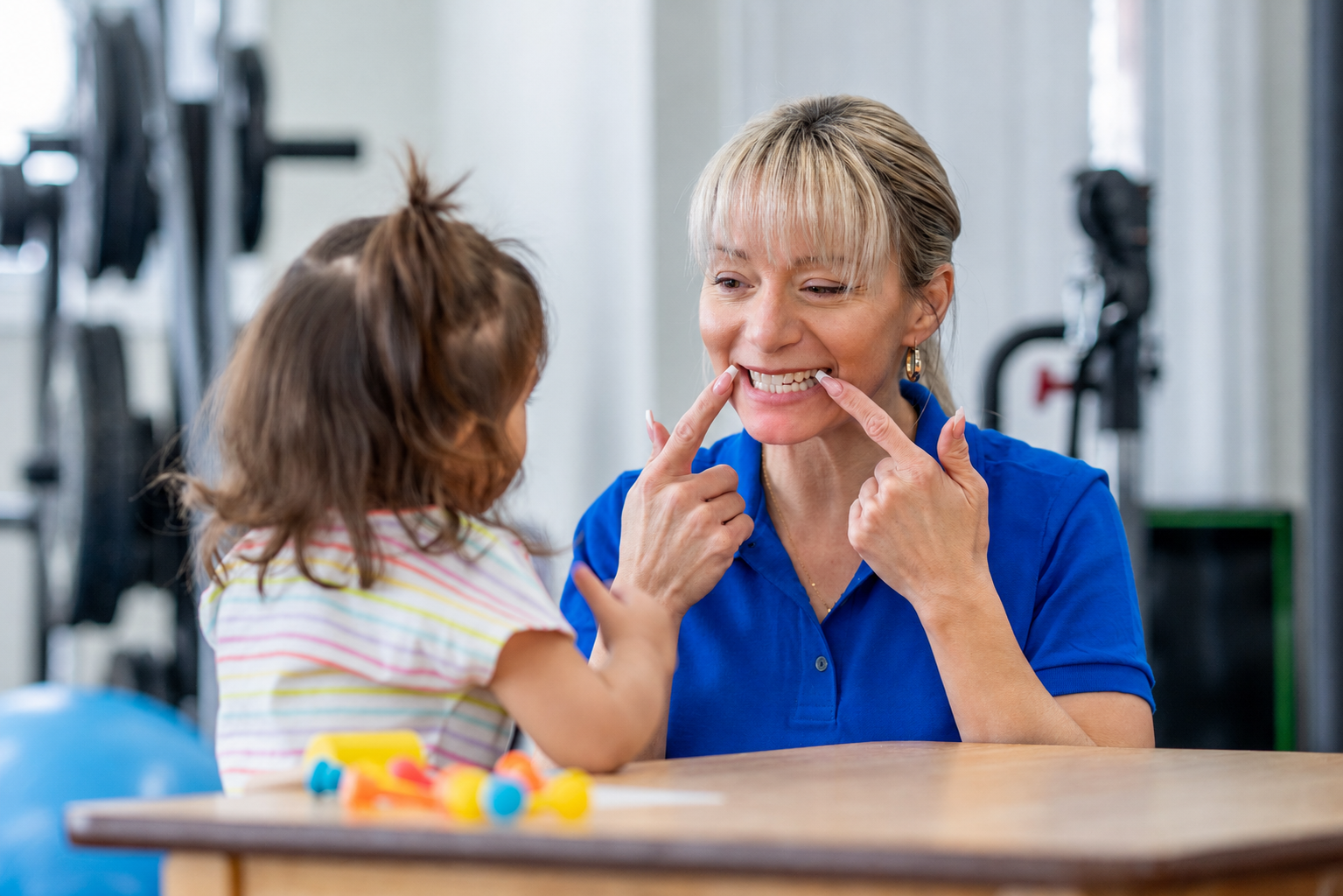
Who may need oral-motor exercises?
1. Children with feeding or swallowing difficulties
Some children need oral-motor support when they have difficulty sucking, chewing, moving food around the mouth, or swallowing safely - often in the context of pediatric feeding disorder, developmental delays, or complex medical histories.
ASHA describes oral-motor treatments as ranging from passive to active, and as "intended to influence the physiologic underpinnings of the oropharyngeal mechanism," directing clinicians to its Pediatric Feeding and Swallowing Evidence Map for the scientific evidence. Evidence for isolated oral-motor and sensory techniques in pediatric feeding remains limited - a systematic review of oral-motor exercises and swallowing in children found mixed findings across all outcomes and insufficient evidence to determine their effects (Arvedson et al., 2010). And because motor learning is task-specific (Kent, 2015), practice should closely match the target skill. In practice, this means therapy should include supported, safe opportunities to practice the actual skill - like chewing food - not only non-food mouth movements.
2. Children and adults with orofacial myofunctional disorders
Orofacial myofunctional disorders, or OMDs, involve atypical movement patterns of the oral and facial muscles. These patterns may affect tongue resting posture, swallowing, breathing, speech production, dental development, and oral control.
ASHA notes that OMDs can occur across the lifespan and may co-occur with speech and swallowing disorders.
Signs may include open-mouth resting posture, abnormal tongue resting posture, tongue thrust during swallowing, lack of lip closure, drooling past the age of 4 years, dental malocclusions, interdental lisps, or difficulty maintaining a consistent lingual-palatal seal.
For these clients, oral-motor or myofunctional goals may include improving tongue resting posture, lip seal, nasal breathing support, jaw-tongue differentiation, tongue-to-palate placement, oral awareness, and functional swallowing patterns.
ASHA emphasizes that OMD management often involves an interprofessional team, including SLPs, dentists, orthodontists, physicians, ENTs, and other relevant professionals.
3. Children with speech sound disorders - with an important caveat
This is where the topic becomes more nuanced.
Some children with speech sound difficulties may also show oral-motor or orofacial patterns that interfere with speech, such as tongue thrust, poor tongue-jaw dissociation, interdental placement, or weak bilabial closure. In these cases, oral-motor work may support awareness, placement, and functional movement patterns that are directly related to speech production.
However, non-speech oral-motor exercises should not be presented as a general treatment for speech sound disorders. A 2015 Cochrane review of non-speech oral-motor treatment for developmental speech sound disorders (evidence current to April 2014) found only three small studies — 22 children in total — with serious methodological limitations, and concluded that there is "currently no strong evidence" that these treatments are effective as a treatment or an adjunctive treatment for children with developmental speech sound disorders (Lee & Gibbon, 2015). ASHA's own systematic review reached a similar conclusion, finding insufficient evidence to support or refute the use of oral-motor exercises to produce effects on speech (McCauley et al., 2009).
So the message is clear: oral-motor exercises may be helpful when a child has a specific oral-motor, structural, sensory, feeding, swallowing, or orofacial myofunctional goal. But for speech sound production, exercises should be closely linked to actual speech movements and should not replace evidence-based articulation or phonological therapy.
4. Adults after stroke, traumatic brain injury, or neurological illness
Many adults need oral-motor or swallowing rehabilitation after a neurological event. Stroke, traumatic brain injury, Parkinson's disease, multiple sclerosis, ALS, dementia, critical illness, intubation, and other neurological or medical conditions can affect the muscles and coordination needed for chewing, swallowing, saliva management, and speech.
ASHA reports dysphagia prevalence across multiple neurological populations, including stroke (29%–64%), Parkinson's disease (35%–82%), multiple sclerosis (24%–34%), dementia (13%–57%), traumatic brain injury (38%–65%), and post-intubation populations (3%–64%) — while cautioning that "the exact epidemiological numbers by condition or disease also remain poorly defined." Signs of dysphagia may include drooling and poor oral management, extra effort or time needed to chew or swallow, oral residue after the swallow, anterior loss of food or liquid, wet or gurgly voice, coughing during or after eating and drinking, recurrent respiratory infections, and weight loss or dehydration. Malnutrition, dehydration, and aspiration pneumonia are among the potential consequences of untreated dysphagia.
For those adults, oral-motor and swallowing goals may include improving tongue strength, oral containment, chewing efficiency, bolus propulsion, airway protection, swallow timing, endurance during meals, and safe oral intake. Treatment must be individualized based on assessment and, when needed, instrumental evaluation such as VFSS or FEES.
5. People with dysphagia after stroke
Post-stroke dysphagia deserves special attention because it is common and can have serious consequences. A Cochrane review notes that swallowing problems after stroke are associated with choking, chest infections, poorer quality of life, longer hospital stay, and increased risk of death or discharge to a care home. The same review (41 trials, 2,660 participants; evidence current to June 2018) found that swallowing therapy did not reduce death or disability overall and did not lead to a safer swallow, but that some individual therapies appeared to improve swallowing ability, reduce hospital length of stay, or reduce the chance of chest infection or pneumonia. The review also noted that evidence quality was generally very low, low, or moderate, and that further high-quality trials are needed (Bath et al., 2018).
This is a good example of why oral-motor and swallowing exercises should be goal-specific and clinician-guided. The right exercise depends on the underlying swallowing physiology, not just the diagnosis.
6. Adults undergoing rehabilitation for head and neck cancer
People treated for head and neck cancer may experience changes in speech, swallowing, jaw opening, tongue mobility, saliva, taste, pain, and oral intake. Surgery, radiation, and chemoradiation can lead to reduced range of motion, fibrosis, trismus, weakness, pain, and dysphagia.
ASHA notes that SLP management may occur before, during, and after cancer treatment. Before treatment, patients may receive education and training in swallowing exercises to avoid or minimize impairment. After treatment, therapy may include speech, voice, and swallowing exercises to mitigate fibrosis-related late effects.
For head and neck cancer rehabilitation, prophylactic and rehabilitative exercises often aim to maintain or restore oropharyngeal and laryngeal strength, range of motion, endurance, swallowing efficiency, and oral intake.
ASHA notes that prophylactic dysphagia treatment usually focuses on maintaining oropharyngeal and laryngeal muscle strength and range of motion, with examples including lingual isometrics, laryngeal elevation, Shaker, EMST, and range-of-motion exercises. These are also exercises where consistent daily repetition - often prescribed as specific hold times and rep counts - matters more than any single session, which makes structured home practice especially important for this population.
Example of a Shaker swallowing exercise video on the Cognishine platform
7. People with progressive neurological conditions
For progressive conditions such as Parkinson's disease, ALS, and some dementias, therapy goals may shift over time. The focus may be maintaining function, supporting safe intake, reducing fatigue, educating caregivers, adapting food and liquid textures, introducing compensatory strategies, and preserving quality of life.
In Parkinson's disease, SLP guidelines include recommendations for dysphagia education, safe swallow strategies, multidisciplinary care, and reassessment. The same guideline also cautions — on expert-opinion grounds — that isolated exercises for respiration, voice, oral-motor function, or articulation are not recommended for improving intelligibility in hypokinetic dysarthria, because of limited consistent improvement. Importantly, that guideline instead strongly recommends intensive voice treatment (LSVT/PLVT), and the large PD-COMM randomized trial has since found LSVT LOUD more effective than no therapy for the patient-reported impact of voice problems (Sackley et al., 2024). The distinction matters: the caution is about isolated, non-functional component exercises, not about intensive, high-effort voice therapy.
In ALS, provisional best-practice guidance recommends speech evaluation at the initial visit, oral structure and motor examination, swallow screening, and comprehensive swallowing evaluation when markers of dysfunction are present. Because ALS is degenerative, that guidance recommends AAC evaluation at the time of diagnosis, regardless of whether a speech impairment yet exists (Pattee et al., 2019).
This is an important clinical message: in progressive conditions, oral-motor exercises may be appropriate for some clients at some stages, but they must be carefully selected to avoid unnecessary fatigue and to match the person's current medical and functional status.
8. Older adults with dysphagia or age-related swallowing changes
Older adults may experience swallowing changes related to frailty, sarcopenia, neurological disease, reduced strength, reduced sensation, dental changes, or medical complexity. Oral-motor and swallowing exercises may sometimes target tongue strength, airway protection, swallow timing, oral control, or mealtime endurance.
A 2025 systematic review and network meta-analysis of swallowing rehabilitation exercises in adults aged 65 and older found significant improvements for certain interventions — the Masako maneuver for dysphagia severity, EMST for aspiration risk, and tongue resistance exercises for tongue strength — but no significant effects for upper esophageal sphincter opening, laryngeal closure, or swallowing-related quality of life, and called for further study of long-term efficacy and optimal training combinations (Chen et al., 2025). In other words, the field is promising, but intervention should still be individualized and outcome-driven.
What goals do oral-motor exercises serve?
Oral-motor exercises may support several clinical goals:
Strength and endurance: supporting the lips, tongue, cheeks, jaw, or swallowing-related muscles when weakness affects function.
Range of motion: helping clients move the tongue, jaw, lips, or soft palate more fully and comfortably, especially after surgery, radiation, neurological injury, or restricted movement patterns.
Coordination: improving the timing and control of oral movements needed for chewing, bolus formation, swallowing, or speech-related placement.
Oral awareness and sensory regulation: helping clients better feel and control oral structures, especially when reduced or heightened oral sensitivity affects feeding or oral function.
Lip closure and oral containment: reducing anterior loss of saliva, food, or liquid.
Tongue movement and bolus control: supporting tongue lateralization, elevation, retraction, and propulsion for chewing and swallowing.
Chewing and feeding efficiency: helping clients manage textures more safely and comfortably.
Saliva management: supporting oral control in clients who drool or have difficulty managing secretions.
Speech support: assisting with placement and movement patterns when there is a clearly identified oral-motor or orofacial myofunctional factor affecting speech — not as a substitute for articulation or phonological therapy.
Home carryover: giving clients and caregivers structured, consistent practice between therapy sessions.
When are oral-motor exercises not enough?
Oral-motor exercises are not appropriate as a blanket solution for every communication or feeding challenge. They should not replace a full SLP assessment, medical evaluation, instrumental swallowing assessment when indicated, or direct speech, feeding, or swallowing treatment.
They are also not a fix for every structural issue. For example, a Royal College of Speech & Language Therapists guideline summarized in ASHA's Evidence Map on velopharyngeal dysfunction states that non-speech oral-motor treatments - including palatal exercises, massage, blowing, sucking, icing, interrupted swallowing, cheek puffing, and gagging - are considered inappropriate interventions for managing speech disorders secondary to velopharyngeal dysfunction (Grade C evidence).
The safest and most evidence-aligned approach is to ask:
• What is the functional problem?
• Which structure or movement is limiting performance?
• Is the exercise directly related to the real-life skill we want to improve?
• How will we measure progress?
Why home practice matters
Many oral-motor and swallowing goals require repetition, consistency, and carryover outside the therapy room. That is where guided home practice becomes especially valuable - and where it also becomes hardest to control. A client who isn't sure if they're moving the right muscle, or a caregiver trying to help a child hold a position correctly, can easily practice the wrong pattern without realizing it. A clear demonstration video and a mirror for real-time visual feedback close that gap - giving the client the same visual check an SLP would give in-room, even when they're practicing on their own.
How can digital tools support oral-motor home practice?
Digital therapy exercises solve three practical problems at once. First, they standardize the model: the client sees the same correct demonstration every time, rather than relying on memory or a handout. Second, they carry the dose with them - prescribed hold times and repetition counts travel home with the client instead of living on a sticky note. Third, they make practice visible, so the clinician can review what was actually done before adjusting the plan. A device-agnostic teletherapy platform means the same activity works in clinic, over a video call, or at the kitchen table, with no downloads and no separate setup for the caregiver.
Final takeaway
Oral-motor exercises can support a wide range of populations: children with feeding or oral-motor delays, clients with orofacial myofunctional disorders, people with dysphagia, adults recovering from stroke or traumatic brain injury, individuals undergoing head and neck cancer rehabilitation, people with progressive neurological conditions, and older adults with swallowing changes.
But the key is clinical reasoning. Oral-motor exercises work best when they are not random movements, but targeted, meaningful, and functional practice. When guided by an SLP - and supported by clear, correctly dosed home practice - they can help clients strengthen skills, improve coordination, support rehabilitation, and continue progressing beyond the therapy session.
Coming soon: you'll find more of these guided, evidence-based therapy activities - like the ones shown above - inside Cognishine's new Oral Motor and Swallowing activities. Built for clinicians as part of our wider library of speech and language therapy tools, it's ready to assign with mirror-based visual feedback, customizable hold times and repetitions, and personalized notes - in therapy, through teletherapy, or at home.
About the author
Alona Novak is a Portugal-based speech and language therapist at Cognishine and a practicing clinician in stroke rehabilitation, working across aphasia, apraxia of speech, and dysarthria. She also works with voice disorders and provides therapy in Hebrew and Russian.
References
American Speech-Language-Hearing Association. (n.d.). Adult dysphagia [Practice portal]. https://www.asha.org/practice-portal/clinical-topics/adult-dysphagia/
American Speech-Language-Hearing Association. (n.d.). Head and neck cancer [Practice portal]. https://www.asha.org/practice-portal/clinical-topics/head-and-neck-cancer/
American Speech-Language-Hearing Association. (n.d.). Orofacial myofunctional disorders [Practice portal]. https://www.asha.org/practice-portal/clinical-topics/orofacial-myofunctional-disorders/
American Speech-Language-Hearing Association. (n.d.). Pediatric feeding and swallowing [Practice portal]. https://www.asha.org/practice-portal/clinical-topics/pediatric-feeding-and-swallowing/
Arvedson, J., Clark, H., Lazarus, C., Schooling, T., & Frymark, T. (2010). Evidence-based systematic review: Effects of oral motor interventions on feeding and swallowing in preterm infants. American Journal of Speech-Language Pathology, 19(4), 321–340. https://doi.org/10.1044/1058-0360(2010/09-0067)
Arvedson, J., Clark, H., Lazarus, C., Schooling, T., & Frymark, T. (2010). The effects of oral-motor exercises on swallowing in children: An evidence-based systematic review. Developmental Medicine & Child Neurology, 52(11), 1000–1013. https://doi.org/10.1111/j.1469-8749.2010.03707.x
Bath, P. M., Lee, H. S., & Everton, L. F. (2018). Swallowing therapy for dysphagia in acute and subacute stroke. Cochrane Database of Systematic Reviews, 2018(10), Article CD000323. https://doi.org/10.1002/14651858.CD000323.pub3
Chen, N. C., Pu, L., & Chen, K. M. (2025). Effectiveness of swallowing rehabilitation exercises in older adults with swallowing disorders: Systematic review and network meta-analysis of randomized controlled trials. Disability and Rehabilitation, 47(26), 6823–6835. https://doi.org/10.1080/09638288.2025.2522790
Kalf, J. G., de Swart, B. J. M., Bonnier-Baars, M., Kanters, J., Hofman, M., Kocken, J., Miltenburg, M., Bloem, B. R., & Munneke, M. (2011). Guidelines for speech-language therapy in Parkinson's disease. ParkinsonNet/National Parkinson Foundation. https://www.parkinsonnet.nl/app/uploads/sites/3/2019/11/dutch_slp_guidelines-final.pdf
Kent, R. D. (2015). Nonspeech oral movements and oral motor disorders: A narrative review. American Journal of Speech-Language Pathology, 24(4), 763–789. https://doi.org/10.1044/2015_AJSLP-14-0179
Lazarus, C., Clark, H., Arvedson, J., Schooling, T., & Frymark, T. (2011). Evidence-based systematic review: Effects of oral sensory-motor treatment on swallowing in adults. American Speech-Language-Hearing Association.
Lee, A. S.-Y., & Gibbon, F. E. (2015). Non-speech oral motor treatment for children with developmental speech sound disorders. Cochrane Database of Systematic Reviews, 2015(3), Article CD009383. https://doi.org/10.1002/14651858.CD009383.pub2
McCauley, R. J., Strand, E., Lof, G. L., Schooling, T., & Frymark, T. (2009). Evidence-based systematic review: Effects of nonspeech oral motor exercises on speech. American Journal of Speech-Language Pathology, 18(4), 343–360. https://doi.org/10.1044/1058-0360(2009/09-0006)
Pattee, G. L., Plowman, E. K., Garand, K. L., Costello, J., Brooks, B. R., Berry, J. D., Smith, R. A., Atassi, N., Chapin, J. L., Yunusova, Y., McIlduff, C. E., Young, E., Macklin, E. A., Locatelli, E. R., Silani, V., Heitzman, D., Wymer, J., Goutman, S. A., Gelinas, D. F., … Green, J. R. (2019). Provisional best practices guidelines for the evaluation of bulbar dysfunction in amyotrophic lateral sclerosis. Muscle & Nerve, 59(5), 531–536. https://doi.org/10.1002/mus.26408
Royal College of Speech & Language Therapists. (2005). Clinical guidelines: 5.5 Cleft palate and velopharyngeal abnormalities. Summarized in ASHA Evidence Maps. https://apps.asha.org/EvidenceMaps/Articles/ArticleSummary/bee26da5-59ab-49bb-b1e0-709879e5dd35
Sackley, C. M., Rick, C., Brady, M. C., Woolley, R., Burton, C., Patel, S., Masterson-Algar, P., Nicoll, A., Smith, C. H., Jowett, S., Ives, N., Beaton, G., Dickson, S., Ottridge, R., Sharp, L., Nankervis, H., & Clarke, C. E. (2024). Lee Silverman voice treatment versus NHS speech and language therapy versus control for dysarthria in people with Parkinson's disease (PD COMM). BMJ, 386, e078341. https://doi.org/10.1136/bmj-2023-078341
