
Rethinking Hierarchy in Motor Speech Therapy: A PROMPT-Informed Perspective

At a glance
What is PROMPT?
PROMPT (Prompts for Restructuring Oral Muscular Phonetic Targets) is a tactile–kinesthetic approach to speech intervention that targets speech motor control through structured touch cues. Rather than focusing only on isolated sounds, PROMPT works across movement patterns, timing, and coordination within meaningful speech.
Who is it best suited to?
PROMPT is particularly appropriate for individuals with motor-based speech disorders, including childhood apraxia of speech, acquired apraxia of speech, and certain profiles of dysarthria. It is most effective for clients who can tolerate tactile input and engage with structured motor practice, and it can be adapted across ages and languages.
Why use a PROMPT-informed approach?
Research and clinical practice consistently show that multisensory cueing, grounded in motor learning principles, supports more accurate and stable speech production. PROMPT emphasizes movement organization and sequencing, which can lead to improved intelligibility and functional communication, especially when auditory and visual cues alone are insufficient.

Rethinking hierarchy in motor speech therapy
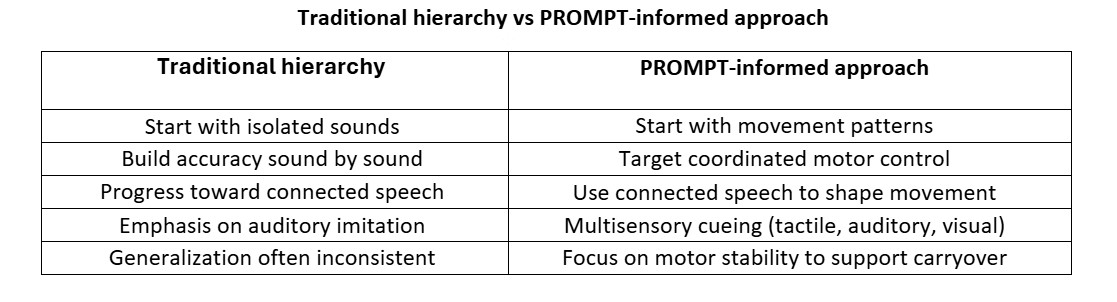
Traditional speech therapy hierarchies often move from isolated sounds to syllables, then words, and only later to connected speech. While this progression can be useful, it assumes that accuracy at lower levels will automatically generalize to functional communication.
PROMPT challenges this assumption by treating speech as a motor act rather than a collection of discrete phonemes. In PROMPT practice, the focus is not on perfecting individual sounds in isolation, but on establishing stable movement patterns that support speech across contexts. In this framework, connected speech is not the final goal alone - it is also a tool for shaping and stabilizing underlying motor representations.
What PROMPT targets beneath the surface
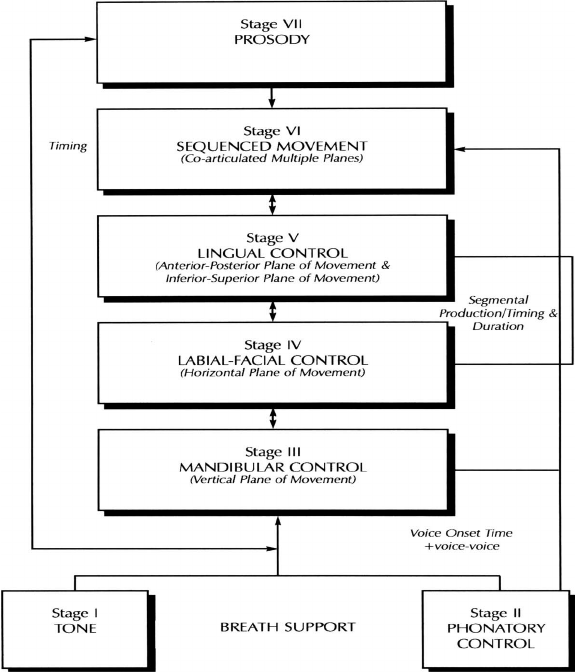
PROMPT intervention is organized around a hierarchy of speech motor control, which reflects the natural development of speech movement. This hierarchy includes:
- Tone and breath support, providing the physiological foundation for speech
- Phonatory control, including voice onset and voicing contrasts
- Mandibular control, supporting vertical movement and stability
- Labial–facial control, enabling lip closure, rounding, and retraction
- Lingual control, involving tongue placement and movement across planes
- Sequenced movement, coordinating multiple articulators across sounds and syllables
- Prosody, including timing, rhythm, and stress patterns in connected speech
These elements are supported through a combination of tactile input, auditory models, and visual cues. In practice, the therapist focuses on one or two specific levels of the motor-speech hierarchy at a time, while the other systems provide background support. The goal is to help the speaker feel the targeted movement patterns, rather than relying only on what they hear or see.
Clinical rationale and evidence
PROMPT is grounded in principles of motor learning and neuroplasticity. Tactile–kinesthetic cues provide additional sensory input that can support motor planning and execution, particularly when internal feedback systems are impaired.
Evidence supporting PROMPT highlights improvements in speech accuracy, consistency, and intelligibility for individuals with motor speech disorders. Clinically, therapists often observe that clients produce more stable and coordinated speech when movement goals are clear and externally supported, especially during early stages of intervention.
PROMPT in adult neurogenic practice
Although PROMPT is frequently associated with pediatric therapy, it has important applications in adult rehabilitation. For adults with apraxia of speech following stroke or brain injury, tactile cues can:
- Reduce trial-and-error speech attempts
- Support relearning of coordinated movement sequences
- Increase confidence and fluency in functional speech tasks
In adult therapy, PROMPT is typically integrated with meaningful vocabulary, real-life phrases, and participation-focused goals.
How to explain PROMPT to a client’s family
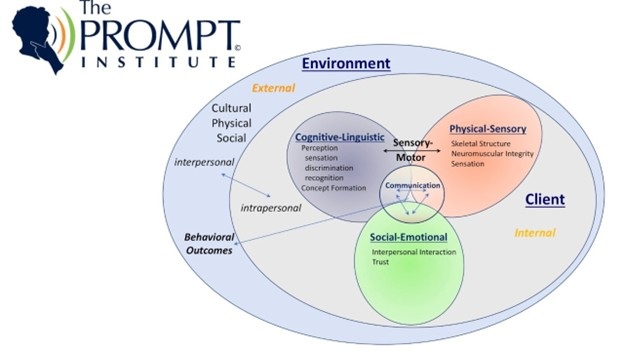
First, we explain that speech does not exist in a vacuum. Clear communication depends on many systems working together - not only knowing the right words or sounds, but also how the body moves, how the brain organizes those movements, how the person understands meaning, and how safe and supported they feel while communicating.
Before introducing the technique itself, it’s important to show the family how complex speech production really is, and how many different abilities are involved in making communication work. This helps them understand that difficulties with speech are not a lack of effort, but a coordination challenge within a very complex system.
From there, we begin by emphasizing the patient’s strengths - what is working well - and use those strengths as a foundation. Only then do we gradually move toward the areas that need support. PROMPT builds on what the person can already do, adding targeted help where the system needs guidance, rather than focusing only on what is difficult.
After covering that, we explain that speech develops in a natural motor hierarchy. Just like other motor skills, speech is built step by step: from basic foundations like muscle tone and breath support, through jaw, lip, and tongue control, and only later toward smooth sequencing and natural prosody.
We go through this hierarchy together to show how speech normally develops and to help the family understand where the person is strong and which levels are already in place.
Only after that do we identify which specific level needs support. We are not “fixing everything at once,” and we are not randomly touching the face. We are targeting a very specific part of the speech system that is not yet stable enough to support clear communication.
Once this picture is clear, we introduce prompting. The touch cues are not the starting point - they come after we understand the motor system. Prompting is simply the tool we use to support the exact movement level that needs help, while relying on the strengths that are already there.
And here is a non-clinician explanation in less than 2 minutes:
FAQ
What is PROMPT?
PROMPT is a tactile–kinesthetic approach that targets speech motor control through structured touch cues to support accurate and coordinated speech movements.
Who is PROMPT suitable for?
It is best suited to individuals with motor-based speech disorders who benefit from hands-on, multisensory support.
How can speech-language therapists use PROMPT in practice?
PROMPT should be used by therapists who have completed formal training, applying tactile cues alongside functional speech tasks and motor learning principles.
Is PROMPT appropriate for everyone?
No. PROMPT is not suitable for all clients and should be used selectively, considering sensory tolerance, cognitive status, and individual response to therapy.
Why might tactile cueing help when auditory cues are not enough?
Touch provides direct information about movement and positioning, which can reduce cognitive load and support more accurate motor planning.
Can PROMPT be used in teletherapy?
While PROMPT itself is hands-on, online therapy tools and teletherapy platforms can still support PROMPT-informed care through motor analysis, hierarchy-based goal setting, caregiver coaching, and accessible therapy software that does not require downloads. Platforms offering therapy activities in multiple languages can further support continuity of care.
For more information visit the official PROMPT website
About the author
Alona Novak is a Portugal-based speech and language therapist at Cognishine and a practicing clinician in stroke rehabilitation, working across aphasia, apraxia of speech, and dysarthria. She also works with voice disorders and provides therapy in Hebrew and Russian.
Key references
Hayden, D. A., & Square, P. A. (1994). Motor speech treatment hierarchy: A systems approach. Clinics in Communication Disorders, 4(3), 162–174.
Hayden, D. A. (2006). PROMPT: A tactually grounded treatment approach to speech production disorders. In R. McCauley & M. Ball (Eds.), Clinical phonology: Assessment and intervention.
Hayden, D. A., Eigen, J., Walker, A., & Olsen, L. (2010). PROMPT intervention for children with severe speech motor delay: A randomized control trial. Journal of Medical Speech-Language Pathology, 18(4), 23–39.
Rogers, S. J., Hayden, D., Hepburn, S., Charlifue-Smith, R., Hall, T., & Hayes, A. (2006). Teaching young nonverbal children with autism useful speech: A pilot study of the Denver Model and PROMPT interventions. Journal of Autism and Developmental Disorders, 36(8), 1007–1024.
Maas, E., Robin, D. A., Austermann Hula, S. N., Freedman, S. E., Wulf, G., Ballard, K. J., & Schmidt, R. A. (2008). Principles of motor learning in treatment of motor speech disorders. American Journal of Speech-Language Pathology, 17(3), 277–298.
The PROMPT Institute. PROMPT Conceptual Framework and Motor Speech Hierarchy. Educational materials and clinical framework published by the PROMPT Institute.
