
Melodic Intonation Therapy (MIT) for Aphasia: A Guide for SLPs

At a Glance
What it is? Melodic Intonation Therapy (MIT) is a structured, evidence-based approach that uses rhythm and changes in pitch to help people with severe non-fluent aphasia produce spoken output. It pairs two-tone melodic patterns and rhythmic hand-tapping with spoken phrases.
Who it’s for? Adults with non-fluent/Broca-type aphasia who have good comprehension and some ability to repeat with support.
Why use it? MIT can help to initiate speech by leveraging melody, rhythm, and left-hand tapping to support motor planning and fluency. Across trials and reviews, MIT shows reliable gains for practiced phrases with variable generalization - making it a useful option for appropriately selected clients.

(Or click here to view Starter Pack in Google Drive)
Includes:
- Blank MIT Phrase Cards with High/Low markings for 2, 3, and 4 syllable phrases.
- MIT Phrase Cards with example phrases and High/Low markings.
-Audio examples of MIT phrases.
- Two sets of audio guide tones (lower and higher pitch).
-One-page evidence summary.
Introduction
Melodic Intonation Therapy (MIT) uses a simple two-note intonation pattern and rhythmic tapping to help people with non-fluent aphasia initiate and shape spoken phrases. This practical guide covers target selection, step-by-step delivery with the MIT hierarchy, a summary of the evidence base, an expanded FAQ, and links to a free MIT Starter Pack.
Why Use MIT?
MIT can activate preserved musical and rhythmic pathways to support speech production, especially when left-dominant language networks are compromised. It provides a highly structured routine that can help to establish short, functional phrases. MIT supports initiation and fluency with a clear, stepwise route for fading cues toward natural speech.
Who Benefits Most?
MIT is best suited to clients with non-fluent/Broca-type aphasia, meaning those who have halting, effortful speech but some ability to repeat words and relatively good comprehension.
The following is a clinical selection checklist for MIT is adapted from Naeser & Helm-Estabrooks (1985) and Helm-Estabrooks & Albert (2004):
Appropriate clients for MIT should demonstrate:
- Good auditory comprehension
- Some facility for self-correction
- Very limited verbal output at baseline
- Adequate attention for brief, structured drills
- Emotional stability/engagement with the task
- Unilateral left-hemisphere damage affecting the language-dominant hemisphere
How MIT Works
- Choose a functional target phrase. Pick a short, meaningful phrase (2–3 syllables) that the person can use in daily life.
- Practice the phrase using a two tone speech pattern. Produce each syllable on a steady High/Low pitch, slightly prolonged. For example,
Good morn - ing
(Low) (High) (Low)
- Tap the left hand once per syllable. The client or clinician taps the client’s left hand in time with the syllables.
- Fade support gradually. Go from unison intoning → clinician fades voice → client intones alone → reduce/remove tapping → work towards more speech-like productions.
How to Deliver MIT
Preparation
Begin by choosing a short, meaningful phrase of two to three-syllables.
Examples: “Good morning.” “Thank you.” “Tea please.” “I need help.” “How are you?”
MIT uses a two-note speech pattern, typically 2–4 semitones apart, to exaggerate the natural stress patterns in speech. You assign the High (H) pitch to stressed syllables and the Low (L) pitch to unstressed ones, so the H/L sequence follows the phrase’s stress pattern.
It may be easier for clients to understand the pattern of high–low–high syllables with three-syllable phrases, so start here if feasible. When the client can intone short phrases reliably, they can then progress to longer phrases of four or more syllables.
Note - the melodic element may not be essential, i.e. strongly rhythmic, slowed speech can capture much of the benefit (Stahl et al., 2013). If your client is not comfortable with the two-note speech pattern of classic MIT then you could use strongly rhythmic, slowed speech instead.
Administering MIT
Work through these steps, only progressing if the client can complete each step with reasonable accuracy (approximately 80% accuracy).
- Explain to the client that you will use a simple two-note “tune” and slow, steady tapping to help the words come. Write out the phrase broken down into syllables. Mark the change in notes with arrows as in the example below.
- Hum and tap together. Start by humming the pattern while the client taps on their left hand once per syllable. Say, “Let’s hum the tune together and tap once for each part of the word.” Keep tempo ~1 beat/second.
If they cannot coordinate the tap at first, provide light hand-over-hand tapping and fade this support as soon as they can tap independently. Keep the tempo slow at roughly one beat per second. Aim for one steady pitch per syllable; make the High–Low contrast clear without worrying about exact musical notes.
In addition to the written cue with high/low syllables marked, you can also use a guide tone or musical instrument (e.g. online keyboard) to reinforce the desired change in tone as the client hums.
Continue for two or three repetitions until the person is moving with you.
- Unison intoning (high support → independent finish). Intone the full phrase together while tapping. Say, “We will say it together and keep the taps steady.” Maintain elongated vowels and a clear High–Low contrast.
On the next trials, start the phrase and fade your voice so the client finishes the last syllable alone. Say, “I will start with you and then you can finish the last bit on your own.
- Client intones solo (moderate support). Ask the person to produce the entire intoned phrase without your voice: “Your turn—same tune, same steady taps.” Offer brief encouragement; keep the pace unhurried. If the client is managing this task, you can add a short delay (e.g. 5-10 seconds) between your model and their attempt.
- Toward speech-like (low support). When the intoned version is reliable, ask for a gentler, more natural contour: “Now try it more like speaking, with a softer tune.” Keep tapping if helpful; remove tapping when no longer needed.
- Use the phrase in context (supporting carry-over). Elicit the phrase in a real exchange. E.g., “What do you say in the morning?” → “Good morning.” “What would you like to drink?” → “Tea please.”
Session Intensity
Most published MIT protocols are intensive: if possible, plan 3–5 clinician-led sessions per week, 30–60 minutes each, for 4–8 weeks. Aphasia-therapy evidence links greater dose and higher session frequency with better outcomes (Bhogal 2003; Brady 2016 Cochrane). If fatigue or capacity limit you, shorten sessions but keep frequency high as distributed practice (short, frequent bouts) supports retention and generalization (Maas 2008).
Home Practice
Give clients and their families a one-page sheet listing three phrases with H/L marks. Ask them to keep practise short and positive; stop if tired; if stuck, hum the pattern while tapping once per syllable, then try again. Recommend that they practise 5–6 days/week in 2–3 very short blocks/day (around 5 min-10 mins per block). This follows distributed-practice principles for speech motor learning and the broader dose/frequency evidence in aphasia (Maas 2008; Cepeda 2006; Schmidt & Lee 2011; Bhogal 2003; Brady 2016).
Evidence
Haro-Martínez et al., 2021
Study design / Participant number: Meta-analysis of 4 RCTs; total ≈94 participants
Main findings: Functional communication and repetition improved for MIT/MIT-like groups vs controls. Effects strongest on trained material; mixed generalisation to untrained items. Protocols and trial quality varied.
Popescu et al., 2022
Study design / Participant number: Systematic review/meta-analysis; mixed designs; pooled N not clearly stated
Main findings: Small–to–moderate effects on expressive outcomes (repetition, phrase production) with considerable heterogeneity. Benefits most consistent when cue-fading and tapping were retained.
van der Meulen et al., 2014
Study design / Participant number: Randomized controlled trial; MIT n=16 vs control n=11 (total n=27)
Main finding: Significant gains on trained repetition/phrases for MIT vs control during sub-acute rehab. Generalisation to untrained material variable; clearest on practised targets.
van der Meulen et al., 2016
Study design / Participant number: Randomised controlled trial; exact total n not clearly stated in summary
Main finding: Improvements on trained phrases after MIT-like intervention in chronic Broca’s aphasia. Limited maintenance/generalisation at follow-up without explicit carry-over.
Schlaug et al., 2009
Study design / Participant number: Intensive MIT cohort; imaging case-series; small sample (single-digit); exact n varies
Main finding: Diffusion imaging showed right-hemisphere white-matter changes associated with intoned-speech practice—plausible neural mechanism for severe non-fluent aphasia. Imaging complements behavioural gains but doesn’t specify dose–response.
Norton et al., 2009
Study design / Participant number: Narrative review
Main finding: Details classic MIT protocol (two-note intoning, left-hand tapping, graded cue-fading) and rationale. Frames MIT as leveraging rhythm/melody and right-hemisphere support to bootstrap propositional speech.
Zumbansen, Peretz & Hébert, 2014
Study design / Participant number: Systematic review; ≈129 participants combined
Main finding: MIT promising for non-fluent profiles, especially on trained materials. Protocol heterogeneity and methodological limits temper claims about generalisation and long-term effects.
Stahl et al., 2013
Study design / Participant number: Controlled experiment in chronic non-fluent aphasia ± AOS; n = 15 (patients received singing therapy, rhythmic therapy, or standard speech therapy)
Main finding: No added advantage of “singing” over rhythmically cued slowed speech; rhythm/tempo likely key active ingredients. Supports rhythm-forward variants when melody isn’t tolerated.
Hurkmans et al., 2012
Study design / Participant number: Systematic review; 15 studies (9 MIT/mod-MIT)
Main finding: Generally positive effects across music-based therapies (including MIT), but study quality and outcomes vary. Supports clinical use with trained-target goals and clear outcome tracking; calls for more rigorous trials.
FAQs
Who taps the hand? The person with aphasia taps their left hand where possible. The clinician may guide the tap early and fade support.
Are two or three-syllable phrases better to begin with? Both can work. Three-syllable (H–L–H) often makes the contrast clearer; two-syllable targets are useful when speech effort is high.
How many sessions are typical? Published research often uses 3–5 sessions per week for 4–8 weeks.
Can MIT also help apraxia of speech? MIT can support initiation and motor planning via rhythm and prolonged syllables.
Can MIT be done at home between sessions with a clinician? Yes. Give clients and their families a one-page sheet listing three phrases with H/L marks. It may also be helpful to make audio recordings of the clinician or the client producing the target phrases that they can use as models during practise. Ask them to keep practise short and positive; stop if tired; if stuck, hum the pattern while tapping once per syllable, then try again. Recommend that they practise 5–6 days/week in 2–3 very short blocks/day (around 5 min-10 mins per block).
Is singing/intoning essential for MIT? The melodic element may not be essential, i.e. strongly rhythmic, slowed speech can capture much of the benefit (Stahl et al., 2013). If your client is not comfortable with the two-note speech pattern of classic MIT then you could use strongly rhythmic, slowed speech instead.
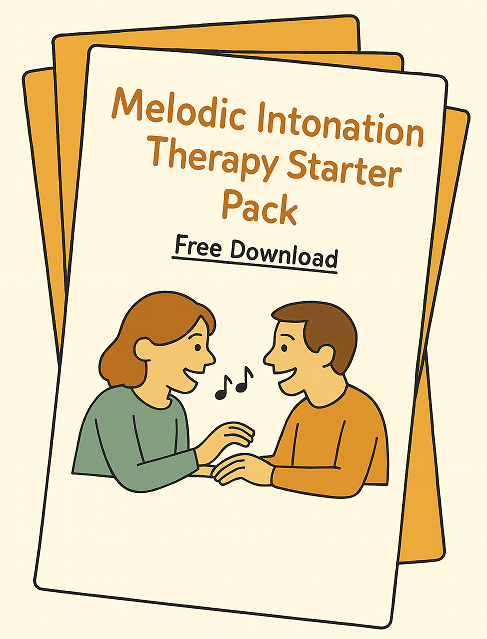
Free Melodic Intonation Therapy Starter Pack - Download Here
(Or click here to view Starter Pack in Google Drive)
- Blank MIT Phrase Cards with High/Low markings for 2, 3, and 4 syllable phrases.
- MIT Phrase Cards with example phrases and High/Low markings.
- Audio examples of MIT phrases.
- Two sets of audio guide tones (lower and higher pitch).
- One-page evidence summary.
About the author
Oli Cheadle is a UK-based speech and language therapist at Cognishine and a practicing clinician in stroke rehabilitation, working across aphasia, apraxia of speech, dysarthria, dysphagia. He also specializes in the therapy for stuttering.
He runs The Aphasia Therapy Planner - a website that helps speech and language therapist find appropriate aphasia therapies for clients https://aphasiatherapyplanner.weebly.com
Oli also runs Stuttering Therapy Online (https://www.stutteringtherapyonline.com), a private therapy practice and hub of information and guides about stuttering.
Explore more aphasia therapy guides and free resources from Cognishine:
Rethinking Hierarchy in Aphasia Therapy: A TUF-Informed Perspective (Treatment of Underlying Forms)
Semantic Feature Analysis (SFA) for Word Finding Difficulties: A Guide for SLPs
References
Albert, M. L., Sparks, R. W., & Helm, N. A. (1973/1975). Melodic Intonation Therapy for aphasia. (Foundational description of MIT protocol; early reports preceding/supplementing the 1974 Cortex paper.)
Bhogal, S. K., Teasell, R., & Speechley, M. (2003). Intensity of aphasia therapy, impact on recovery. Stroke, 34(4), 987–993.
Brady, M. C., Kelly, H., Godwin, J., Enderby, P., & Campbell, P. (2016). Speech and language therapy for aphasia following stroke. Cochrane Database of Systematic Reviews, 2016(6), CD000425.
Cepeda, N. J., Pashler, H., Vul, E., Wixted, J. T., & Rohrer, D. (2006). Distributed practice in verbal recall tasks: A review and quantitative synthesis. Psychological Bulletin, 132(3), 354–380.
Haro-Martínez, A. M., & Lubrini, G. (2021). Efficacy of Melodic Intonation Therapy for aphasia: A meta-analysis of randomized controlled trials. Brain Sciences, 11(9), 1208.
Helm-Estabrooks, N., Nicholas, M., & Morgan, A. (1989). Melodic Intonation Therapy: Materials and Procedures. Austin, TX: PRO-ED.
Helm-Estabrooks, N., & Albert, M. L. (2004). Manual of Aphasia and Aphasia Therapy (2nd ed.). Austin, TX: PRO-ED.
Hurkmans, J., de Bruin, M., Boonstra, A. M., Jonkers, R., Bastiaanse, R., Arendzen, H., & Reinders-Messelink, H. A. (2012). Music in the treatment of neurological language and speech disorders: A systematic review (incl. MIT/mod-MIT). Aphasiology, 26(1), 1–19.
Maas, E., Robin, D. A., Hula, S. N. A., Freedman, S. E., Wulf, G., Ballard, K. J., & Schmidt, R. A. (2008). Principles of motor learning in treatment of motor speech disorders. American Journal of Speech-Language Pathology, 17(3), 277–298.
Naeser, M. A., & Helm-Estabrooks, N. (1985). CT scan lesion localisation and response to Melodic Intonation Therapy in nonfluent aphasia. Cortex, 21(2), 203–223.
Norton, A., Zipse, L., Marchina, S., & Schlaug, G. (2009). Melodic Intonation Therapy: Shared insights on how it is done and why it might help. Annals of the New York Academy of Sciences, 1169(1), 431–436.
Popescu, M., et al. (2022). Melodic Intonation Therapy: Systematic and “affinity” meta-analysis. ASHA Convention Proceedings (synthesis report).
Schlaug, G., Marchina, S., & Norton, A. (2008/2009). Neural plasticity and network reorganization with intoned speech therapy in chronic nonfluent aphasia. (Neuroimaging cohort reports describing right-hemisphere engagement/white-matter change associated with MIT-style practice.)
Schmidt, R. A., & Lee, T. D. (2011). Motor Control and Learning: A Behavioral Emphasis (5th ed.). Champaign, IL: Human Kinetics. (Distributed practice / dosage principles.)
Sparks, R. W., Helm, N. A., & Albert, M. L. (1974). Aphasia: Melodic Intonation Therapy. Cortex, 10(3), 303–316.
Stahl, B., Henseler, I., Turner, R., Geyer, S., & Kotz, S. A. (2013). How to engage the right hemisphere in aphasia without singing: Evidence for two routes of speech recovery. Frontiers in Human Neuroscience, 7, 35.
van der Meulen, I., van de Sandt-Koenderman, M. W. M. E., Heijenbrok-Kal, M. H., Visch-Brink, E. G., & Ribbers, G. M. (2014). The efficacy and timing of Melodic Intonation Therapy in subacute aphasia: A randomized controlled trial. Neurorehabilitation and Neural Repair, 28(6), 536–544.
van der Meulen, I., van de Sandt-Koenderman, M. W. M. E., & Ribbers, G. M. (2016). Melodic Intonation Therapy in chronic aphasia: Evidence from a randomized controlled study. Brain and Language, 149, 1–8.
Zumbansen, A., Peretz, I., & Hébert, S. (2014). Melodic Intonation Therapy: Back to basics for future research. Frontiers in Neurology, 5, 7.
